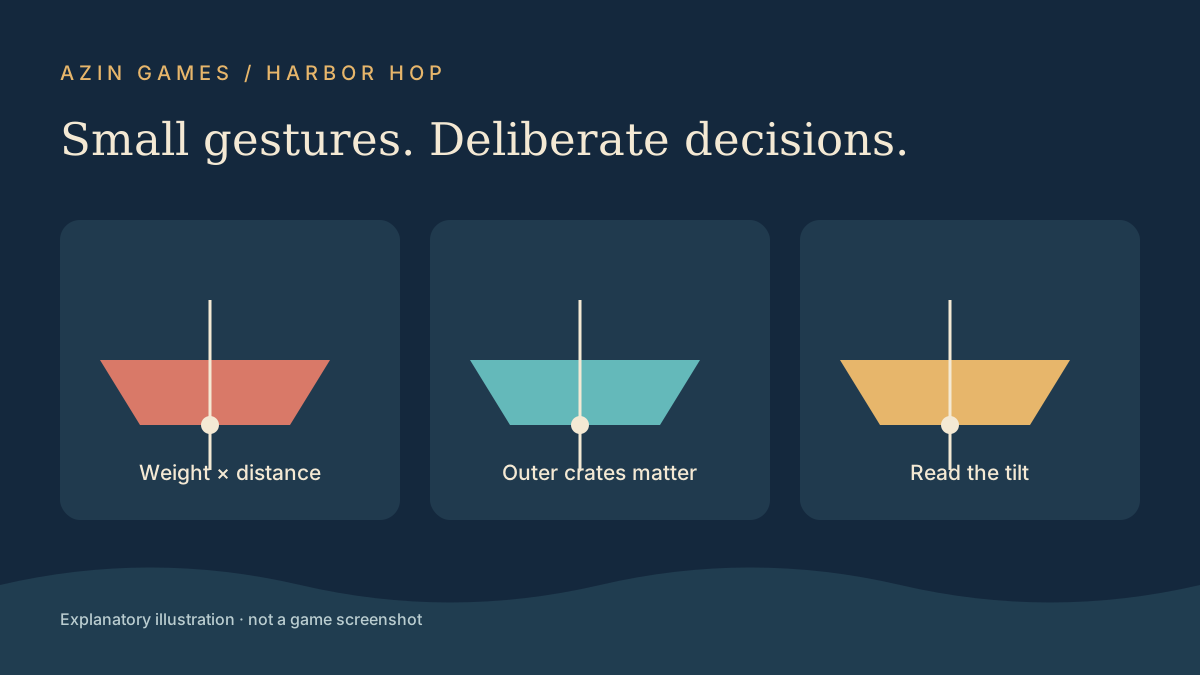
A boat can lean even when both sides contain the same number of fish. Harbor Hop considers their weight and their distance from the boat’s center. This explains why one heavy catch near an edge can matter more than several small catches closer to the middle.
Weight and position work together
In version 0.2.0, the ordinary small, medium and large fish have relative weights of 1, 2 and 5. The four crate positions are −160, −55, +55 and +160 in the game’s local coordinates. These are game units, not kilograms or real boat measurements. A weight of 5 at +160 contributes +800 to the load moment; the same fish at +55 contributes +275.
There is an important color trade-off: the crates have fixed colors, so moving a catch inward may cause a mismatch. The goal is to manage the catches you take, their landings and the current mode—not to put every fish in the middle.
Try a simple load experiment
Move the four sliders below. The calculation uses the same crate positions, tilt gain and failure angle as the current game. It shows the target tilt for an example load. The real boat approaches that tilt over time; the tool does not reproduce its motion, fish flight or crate overflow.
Two useful examples
Symmetric load: one weight-5 fish at each outer edge gives −800 +800 = 0. Their moments cancel. Unequal positions: a weight-5 fish at the right edge and one weight-5 fish in the inner left crate give +800 −275 = +525. Equal weight on each side does not guarantee balance.
Do not read the meter as a promise of instant safety. The boat is moving toward its target angle. A second heavy arrival on the loaded side can remove the time you expected to have.
Overflow is not a score strategy
Crates have weight limits. When a new arrival would exceed a limit, older fish can fall out. Their earlier score contribution is reversed, so repeatedly filling one crate is not a reliable way to farm points. A full outer crate can also reach the tipping limit before that spill helps you.
A routine for your next Classic run
- Check which side is leaning after each landing.
- Notice heavy fish before building another chain.
- Use a golden fish’s any-color match deliberately when it offers a useful landing.
- Let a risky fish pass rather than forcing a bad deposit.
Practice mode disables balance. Use Classic to test these decisions, and consult the combo guide when you are ready to combine timing with load management.
Put the idea into play
The Android public release is being prepared. The web version may show age and profile steps.
Open the web version ↗Explore Harbor Hop