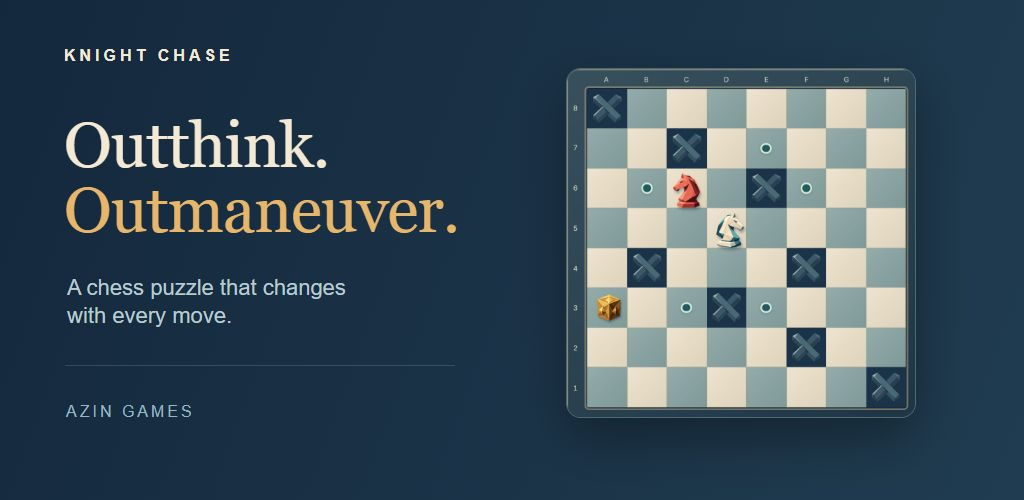
The knight is one of the most interesting pieces in chess. Unlike any other piece, it moves in an "L" shape and can jump over other pieces. This unique movement makes the knight both tricky for beginners and powerful for experts.
The Basic Movement
The knight moves in an L-shape pattern:
- 2 squares in one direction (horizontally or vertically)
- 1 square perpendicular to that direction
Or you can think of it as:
- 1 square in one direction
- 2 squares perpendicular to that direction
Knight Movement Diagram
  . X . X .

  X . . . X

  . . ♞ . .

  X . . . X

  . X . X .
The knight (♞) can move to any square marked with X
Key Properties of the Knight
1. Jumping Over Pieces
The knight is the ONLY chess piece that can jump over other pieces. It doesn't matter what's in its path—only the destination square matters. This makes the knight especially powerful in crowded positions.
2. Color Switching
Every move, the knight changes the color of the square it's on. If it starts on a white square, it will land on a black square, and vice versa. A knight can never move to a square of the same color!
3. Eight Possible Moves
From a central position, a knight has 8 possible moves. However, from a corner, it only has 2 moves. This is why knights are usually stronger in the center of the board.
💡 Pro Tip: "A knight on the rim is dim!" - Keep your knights toward the center for maximum mobility.
Knight Strategies
Forking
Because the knight attacks in unusual patterns, it's excellent for "forking" - attacking two pieces at once. A knight fork on the king and queen is devastating!
Outposts
An "outpost" is a square where your knight is protected and can't be attacked by enemy pawns. Knights on outposts can dominate the game.
Knight vs Bishop
In closed positions (lots of pawns blocking the center), knights are often stronger than bishops. In open positions, bishops tend to be stronger due to their long-range abilities.
Practice Makes Perfect
The best way to master knight movement is practice! Try these exercises:
- Knight's Tour - Move a knight to every square on the board exactly once
- Knight Chase - Our game! Practice L-shaped movement against opponents
- Puzzle Solving - Chess puzzles often feature tactical knight moves
Master the Knight in Knight Chase!
Our game is entirely based on knight movement. Practice your L-shaped thinking while having fun!
Play Knight Chase FreeCommon Mistakes
- Leaving knights on the edge - They have fewer moves from the rim
- Moving the same knight repeatedly - Develop all your pieces!
- Forgetting the color change - Remember, knights always switch colors
Conclusion
The knight's L-shaped movement makes it unique among chess pieces. Its ability to jump, combined with its unusual attack pattern, makes it a powerful tactical weapon. Whether you're playing traditional chess or Knight Chase, mastering the knight will make you a better player!
Happy playing, and may your knights always find the right squares! ♞